By Dave Chen | Home Electrical & Appliance Troubleshooting
Disclosure: This article contains affiliate links. If you purchase through these links, we may earn a small commission at no extra cost to you. As an Amazon Associate, we earn from qualifying purchases.
The pattern of flickering lights — one room vs the whole house — is the single most useful piece of information you already have. Before you touch a switch, open an outlet box, or call an electrician, where the flickering is happening tells you which part of your electrical system is involved.
Get that answer right first, and you’ll spend your time in the right place. This guide uses that one-room vs whole-house pattern to walk you through each scenario, what causes it, and what to do next.
Why Flickering Lights One Room vs Whole House Is Your First Diagnostic Clue
Think of your home’s electrical system in layers. At the bottom are individual fixtures and bulbs. Above that are circuits and switches. Above that is your main panel. And above that is the utility service connection coming into your home from the street.
Flickering in one room points to the bottom layers — that circuit, its fixtures, its switches, or the bulbs themselves. Whole-house lights flickering points to the top layers — the main panel or the utility service. And flickering that only happens when a large appliance starts is a third distinct pattern that deserves its own look.
Use this framework to self-select into the right section below. Don’t mix them — the causes, the fixes, and the safety considerations are genuinely different.
Flickering Lights in One Room Only: Causes and What to Check
The most common cause of flickering lights in one room only is a loose connection somewhere on that room’s circuit — at the fixture itself, at the switch, or at an outlet that feeds the same circuit.
Loose connections are so common because wiring connections can work loose over time through normal thermal cycling. Wires expand and contract slightly with heat. A connection that’s 90% secure will carry current most of the time but create a brief interruption — a flicker — whenever load or temperature shifts slightly.
Secondary Causes, in Order of Likelihood
- LED bulb and dimmer incompatibility. If you have LED bulbs on an older dimmer switch, the dimmer may not be designed to work with LEDs. LEDs have very different electrical characteristics than the incandescent bulbs older dimmers were built for. This causes a buzzing or flickering effect specific to that circuit. Understanding the differences covered in Smart Dimmer Switch vs. Standard Dimmer: Which One Actually Stops LED Flickering can help you choose the right replacement — not just swap out the wiring. If this matches your situation, replacing it with an LED-compatible smart dimmer switch is the fix — not the wiring.
- A failing or worn light switch. Switches have a limited mechanical lifespan. An aging switch can make intermittent contact, causing the light to flicker when the switch is in the on position. If the flickering happens specifically when you touch or operate the switch, this is likely the cause.
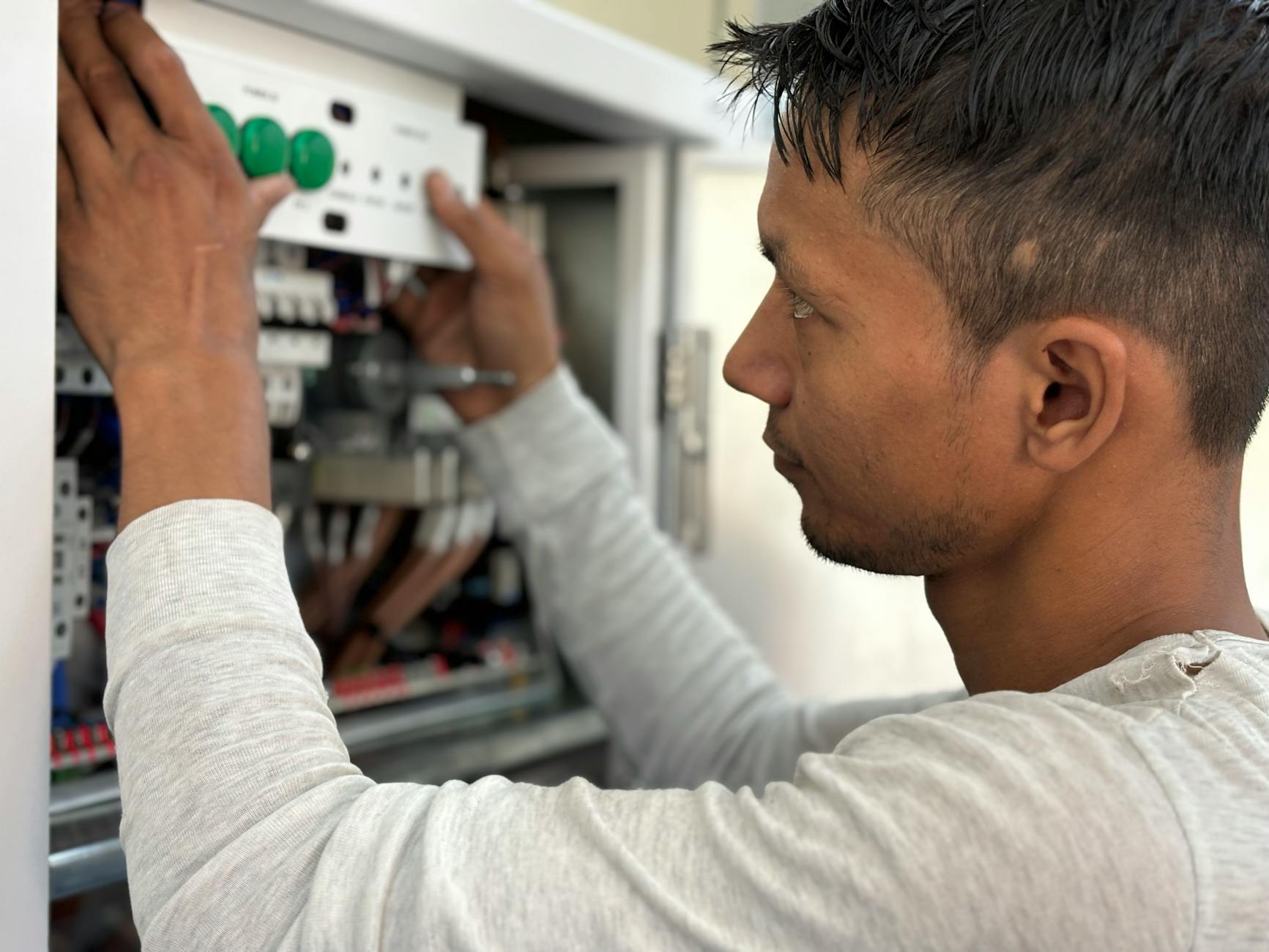
- A loose wire at the circuit breaker terminal. Each circuit connects to a breaker at your main panel. If that terminal is loose, it can cause intermittent behavior on that entire circuit. This is toward the edge of what a homeowner should handle. Working near live bus bars in a panel requires care — call a professional for this one unless you’re confident with panel work.
How to Narrow It Down
Ask yourself these questions before you open anything:
- Does the flickering happen when you touch or operate the switch? If yes, the switch is the primary suspect. Flickering happens when you touch or operate the switch — this is a separate diagnostic path covered in detail in its own article, and worth reading if this matches your situation.
- Do you have LED bulbs on a dimmer switch? If yes, dimmer/LED incompatibility is likely. An LED-compatible dimmer switch is the usual fix for this pattern. See the dimmer compatibility article for full coverage on selecting the right dimmer for LED bulbs.
- Does the flickering happen randomly, with no switch interaction? If yes, you’re likely looking at a loose connection at the fixture, junction box, or socket.
Safe First Checks (Without Opening Anything)
- Try a different bulb in the affected fixture. A failing bulb can cause flickering at that fixture only. Rule this out before assuming wiring.
- Toggle the breaker for that circuit off and back on. This isn’t a repair — it’s a check. If the flickering stops temporarily, that’s a clue the breaker terminal connection may be involved.
- Note whether any outlets in the same room also show intermittent behavior. If they do, the problem is upstream of the fixture — likely a loose connection in a junction box or at the breaker.
The Right Tool Before You Open Anything
If you’re going to open a switch box, outlet box, or fixture box to inspect connections, a non-contact voltage tester is the minimum safety tool you need. It lets you verify that power is actually off before you touch any wire. Toggle the breaker, then use the tester to confirm. Never assume the power is off — always verify. If you haven’t chosen a tester yet, this guide to the Best Voltage Testers for Diagnosing Flickering Lights and Electrical Problems covers the top options worth considering.
What Not to Do
Do not assume it’s just the bulb and ignore persistent one-room flickering. Loose connections that arc generate heat at the connection point. Over time, that heat can damage insulation and create a fire risk. A flicker that keeps coming back after you’ve swapped the bulb needs to be investigated. If you suspect the wiring is the culprit, How to Diagnose a Loose Wire Causing Flickering at a Light Switch or Fixture walks through the full process for tracing and confirming the fault before you open anything.
Do not tighten wire connections at the main panel yourself unless you are comfortable working in close proximity to live bus bars. That’s the line between homeowner-manageable and professional territory.
Whole House Lights Flickering: When the Cause Is Upstream of Your Panel
If lights are flickering on multiple circuits throughout the house — in rooms that aren’t on the same breaker — the problem isn’t a circuit or a fixture. You’re dealing with something upstream of the entire panel.
The most common whole house lights flickering cause is a problem at the utility service connection or the main panel itself.
The Two Most Likely Scenarios
1. Loose neutral at the service entrance or meter base.
This is the most serious cause — and one of the more common ones. Your home gets power through a service entrance. That’s the wires running from the utility pole or underground to your meter and into your main panel. One of those conductors is the neutral. It provides the return path for current.
If the neutral connection becomes loose, voltage across your two hot legs becomes unstable. Lights may brighten and dim inconsistently. Some appliances may behave strangely. You might notice some lights getting unusually bright on one circuit while others dim on another. This is a classic lost neutral pattern, and it’s high urgency.
2. Main breaker connection issue.
Less common, but the main breaker itself can develop a loose connection. The symptom pattern is similar — intermittent voltage fluctuation across the whole panel.
Other causes worth knowing:
- Neighbors on the same utility transformer experiencing high demand can cause brief voltage fluctuations that affect your whole house. This is a utility-side issue, not something inside your home.
- General utility voltage fluctuations from the street — again, nothing you can address yourself.
How to Confirm It’s Truly Whole-House
Before escalating, confirm the pattern. Check lights in multiple rooms that you know are on different breakers. If lights throughout the house flicker across circuits you can identify as separate, it’s whole-house. Checking two or three clearly separate areas — a bedroom, the kitchen, and an exterior light — is a reasonable confirmation.
This Is Not a DIY Repair
A loose neutral at the service entrance is a utility or licensed electrician repair. Full stop. The voltage swings it can cause are dangerous — to your appliances, and potentially to people in the home.
What to do: Call your utility company first. They can inspect the meter and service connection at no charge in most cases. If they check the utility side and clear it, the problem is on your side of the meter. Call a licensed electrician to inspect the main panel and service entrance wiring.
Flickering That Follows Appliance Use: A Pattern Worth Noting
If your lights dim or flicker specifically when a large appliance kicks on — refrigerator compressor, central HVAC, washing machine motor, microwave — this is a distinct pattern with a different cause.
Large appliances draw a significant surge of current when their motors start. That brief current demand can pull voltage down slightly on nearby circuits, causing lights to dim momentarily. In older homes with more modest electrical service, this is not unusual.
When It’s Probably Fine
- The flicker or dimming lasts one second or less after the appliance starts
- It’s limited to lights on circuits physically near the appliance
- The appliance itself starts and runs normally
In this case, you’re seeing normal physics. Note it, but it doesn’t necessarily require repair.
When It’s Not Fine
- Flickering lasts more than a second or two after startup
- Lights on circuits nowhere near the appliance are affected
- The appliance seems to struggle or hesitate when starting
Prolonged or widespread flickering from appliance startup suggests the panel or service capacity may be undersized for the load on the home. This is an assessment for a licensed electrician — not something you can address with a DIY fix.
When Any Flickering Pattern Means Call an Electrician Now
Regardless of whether you’re seeing flickering lights in one room or whole-house flickering, stop diagnosing and call a licensed electrician immediately if you observe any of the following:
- Flickering accompanied by a burning smell. A burning smell near an outlet, switch, or fixture means something is overheating.
- Warm outlet or switch covers. Covers should never feel warm to the touch.
- Visible sparking or scorch marks at any fixture, switch, or outlet.
- Flickering that started suddenly after a storm or power outage. Utility events can damage service connections.
- Some lights flickering while others get unusually bright at the same time. This is a possible lost neutral — high urgency. Appliances and electronics in the home can be damaged quickly, and the shock and fire risk is real.
- Breakers tripping in conjunction with flickering.
These are active fault conditions. Stop. Call a professional.
How to Use the Pattern to Decide Your Next Step
Here’s the short version for quick reference:
| What You’re Seeing | What It Points To | Next Step |
|---|---|---|
| One room, flickering when you operate the switch | Failing switch or loose connection at switch box | Inspect the switch; replace if worn |
| One room, LED bulbs on a dimmer | Dimmer/LED incompatibility | Replace with an LED-compatible dimmer |
| One room, random flickering with no trigger | Loose connection at fixture or junction box | Try a new bulb first; then inspect fixture wiring with NCV tester confirming power off |
| Whole house flickering | Utility service or main panel issue | Call utility company first, then licensed electrician |
| Follows appliance startup, brief | Normal starting current draw | Monitor; not urgent |
| Follows appliance startup, prolonged or widespread | Possible undersized service | Licensed electrician assessment |
| Any red-flag symptom (smell, heat, sparking, bright/dim split) | Active fault | Stop. Call licensed electrician now. |
Prevention
A few habits that keep flickering from becoming a bigger problem:
- Have a licensed electrician inspect your panel and service entrance every 10–15 years, or after any major storm. Connection integrity degrades over time. Cheap to check, expensive to fix after it fails.
- Use bulbs rated for your fixture and dimmer. Check the fixture’s maximum wattage label and verify dimmer/bulb compatibility before installing LEDs on a dimmer circuit.
- Avoid loading high-draw appliances on the same circuit as sensitive lighting. If your kitchen lights flicker every time the microwave runs, that circuit may be carrying more than it was designed for.
Frequently Asked Questions
Why do my lights flicker only at night?
This usually correlates with increased load on the grid during peak evening hours. More households are running appliances, HVAC systems, and lighting at the same time. Utility-side voltage fluctuations are common during these periods. Appliance cycling inside your home — refrigerators, HVAC units kicking on — can also contribute. If the flickering is mild and only at night, the cause may be outside your home entirely.
Can a bad light bulb cause flickering throughout the whole room?
A failing bulb affects only that fixture. If multiple fixtures in the same room are flickering, the cause is upstream of the bulbs — likely a loose connection on that circuit or at the switch. If fixtures on different circuits are affected, the problem is further upstream still.
Is it safe to ignore occasional flickering?
Brief, infrequent flickering tied to appliance startup may be harmless in older homes. But persistent or unexplained flickering always warrants diagnosis. The risk isn’t just inconvenience — loose connections that cause flickering can generate enough heat over time to damage insulation and start a fire.
Can flickering lights cause a fire?
Yes. If the cause is a loose connection or arcing at a wire junction, heat builds up at that point over time. That heat can ignite surrounding material — insulation, wood framing, junction box materials. This is why persistent flickering should never be dismissed as a minor annoyance.
Does flickering mean my wiring is old and needs full replacement?
Not necessarily. Many flickering issues have specific, fixable causes — a worn switch, an incompatible dimmer, a single loose terminal. Age is a contributing factor, but the pattern tells you more than the age does. Diagnose by location first before assuming the whole system needs work.
What should I tell the utility company when I call?
Describe when the flickering occurs, whether it affects the whole house or just part of it, and whether it started after a storm or power interruption. Note whether any appliances have been behaving strangely — this helps them distinguish between a voltage fluctuation issue and a lost neutral. They’ll typically send a technician to check the meter and service drop at no charge.
Understanding the difference between flickering lights in one room vs the whole house is the fastest way to stop guessing and start diagnosing. Use the pattern you’ve already observed, follow it to the right section, and you’ll know quickly whether this is something you can handle yourself, something to hand off to your utility, or something that needs a licensed electrician. If you’re seeing the switch-triggered pattern specifically, the switch diagnosis article covers that path in detail. If LED dimmer flickering is your issue, the dimmer compatibility article walks through the fix step by step.

Home Electrical & Appliance Troubleshooting