Most drywall cracks are cosmetic — caused by normal house settling or seasonal wood movement — and pose no structural risk. But some are early warning signs of something more serious. Understanding the hairline crack vs structural crack drywall distinction is what determines your next step. This article walks you through a clear diagnostic process so you can read what you are looking at before deciding whether to grab a putty knife or call an engineer.
Disclosure: This article contains affiliate links. If you purchase through these links, we may earn a small commission at no extra cost to you. As an Amazon Associate, we earn from qualifying purchases.
What Causes Cracks in Drywall in the First Place
Understanding the cause helps you read the crack. The most common cause is normal house settling. As lumber dries and shrinks over time, the structure shifts slightly. Drywall is rigid, so it responds with small cracks — especially at taped seams and around openings.
Seasonal movement is the second most common driver. Humidity and temperature cycles expand and contract wood framing throughout the year. This stress shows up at corners, along seams, and at the edges of door and window frames.
Poor installation also produces cracks. Inadequate fasteners, untaped joints, or joint compound applied too thick can all cause surface cracking that looks alarming but is purely cosmetic.
Actual structural or foundation movement is the least common cause. It produces distinct patterns that are different from settling cracks. The goal of this article is to help you tell which category you are dealing with.
How to Identify a Hairline Crack in Drywall and Confirm It Is Cosmetic
A hairline crack is less than 1/16 inch wide, shallow, and does not go through the drywall panel. These are very common and, in most cases, nothing to worry about.
Common locations for hairline cracks:
- Along taped seams between drywall panels
- At the corners of door and window frames
- At ceiling corners near exterior walls
- Along the ceiling-wall joint
Characteristics that confirm a crack is cosmetic:
- No displacement. Run your finger across the crack. Both sides sit at the same height — there is no step or ridge between them. This is the single most important check.
- It follows the seam or tape line. Cracks that track along a known joint rather than cutting diagonally across the panel are almost always settling or tape failures.
- No moisture signs. No discoloration, soft or spongy drywall, staining, or musty odor near the crack.
- It has been stable. The crack has not visibly grown or changed over several weeks of observation.
If all of these apply, you are almost certainly looking at a normal settling or seasonal movement crack. It is safe to repair yourself once you have confirmed it is not growing.
Before you repair anything, mark both ends of the crack with a pencil and date it. If you want to track growth more precisely — useful if you plan to sell or want documentation — a crack monitoring gauge (also called a tell-tale) gives you a clear, measurable record. Crack monitoring gauges are available on Amazon and cost very little for the certainty they provide.
Warning Signs Your Drywall Crack Is Structural, Not Cosmetic
This is where the hairline crack vs structural crack drywall distinction becomes critical. One sign alone may not confirm a structural problem, but several together should prompt a professional assessment.
The clearest single warning sign: displacement. Run your finger across the crack from one side to the other. If one side is higher than the other — if there is a step or ridge — the wall has actually moved. That is displacement, and it is the most reliable indicator that something structural is happening.
Other structural warning signs:
- The crack is wider than 1/4 inch at any point
- The crack runs diagonally at roughly 45 degrees from a door or window corner and is accompanied by other symptoms
- Multiple cracks are appearing in the same area, or similar cracks are visible on both sides of the same wall
- Doors or windows nearby have recently started sticking, swinging open on their own, or failing to latch
- Cracks are accompanied by sloping floors, gaps at baseboards, or separation at ceiling-wall joints
- New cracks appeared rapidly after a triggering event — heavy rain, nearby excavation, or seismic activity
Important clarification: Structural does not automatically mean the house is in immediate danger. It means something is moving that should not be moving. A structural engineer or foundation specialist needs to evaluate it. A structural engineer assesses the problem objectively — they do not sell repairs, which makes them the right first call when you have genuine concerns.
Hard stop: Do not patch a crack that shows any of these signs and assume the problem is solved. Cosmetic repair hides the evidence without fixing the cause. If the underlying movement continues, the crack will return — and you will have lost the ability to track its progression.
Crack Patterns That Tell You More Than Size Alone
The shape and location of a crack often reveals more than its width does. Here is how to read the most common patterns.
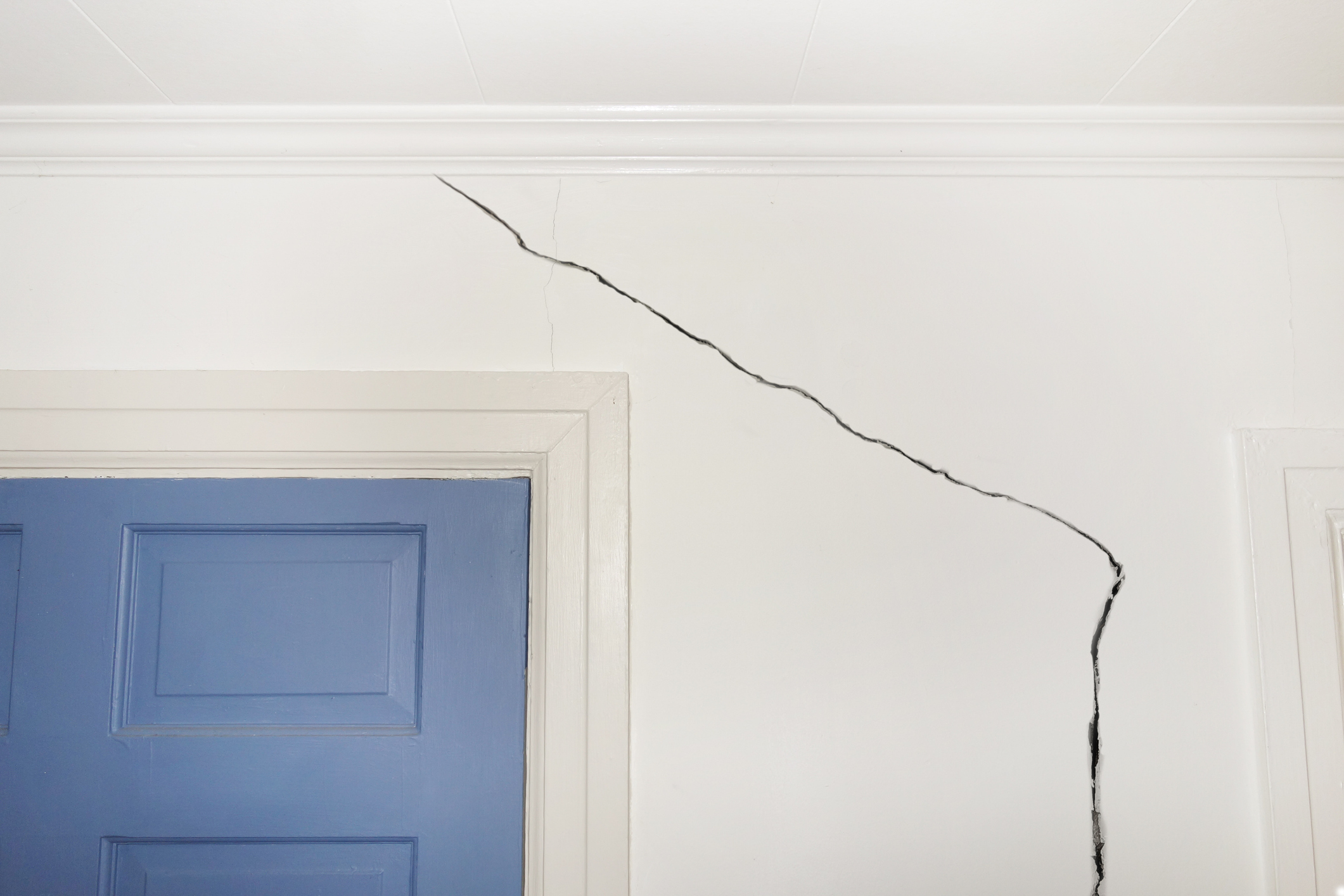
Single diagonal crack from a door or window corner This is one of the most common cracks in any home. It typically runs at 45 degrees from the corner of a frame. On its own, it almost always reflects normal settling. It becomes a structural concern only when paired with door or window function problems, displacement at the crack, or other warning signs.
Long horizontal crack at the ceiling-wall joint Usually caused by seasonal movement at the top plate — the horizontal framing member at the top of a wall. Monitor it through a full seasonal cycle before acting. If it widens in winter and closes in summer, that is a humidity and framing response — manageable, not structural.
Horizontal crack running along a wall at mid-height This pattern can indicate lateral soil pressure pushing against a wall. On a foundation or basement wall, it is serious and needs prompt professional attention. On an interior drywall wall far from the foundation, it is far less concerning — but still worth monitoring.
Spider or map cracking A web of fine surface cracks with no consistent direction. Almost always a finish issue — joint compound applied too thick, or incompatible paint and primer. Purely cosmetic.
Stair-step cracks following mortar joints Relevant in brick or concrete block construction. This pattern is a classic sign of differential settlement — one part of the foundation sinking faster than another. Take this seriously and get a professional assessment.
Recurring crack in the same spot after repair If you have repaired a crack and it has returned in the same location within a season or two, the underlying movement has not stopped. Do not simply patch it again. Investigate the cause first.
When to Fix It Yourself vs. Call a Professional
Fix it yourself if:
- The crack is hairline width with no displacement
- It has been stable for at least 2–4 weeks of monitoring
- Location matches a known settling pattern — taped seam, door corner, ceiling-wall joint
- No associated symptoms such as door problems, floor changes, or moisture
For confirmed cosmetic hairline cracks, the right repair material depends on the location. Use flexible paintable caulk or all-purpose joint compound for cracks at moving joints like the ceiling-wall seam or around door frames. Flexible caulk moves with the joint rather than cracking again. Use all-purpose joint compound with mesh tape for cracks along stable panel seams. Avoid rigid spackling paste for any crack that runs along a seam or joint — it does not flex with seasonal movement and will re-crack within a year. For the drilling and driving work involved in any drywall repair — setting screws, reattaching loose panels, or securing backing boards — a quality drill and driver set makes the job noticeably faster and cleaner.
Call a licensed professional if:
- Any displacement exists between the two sides of the crack
- The crack is wider than 1/4 inch
- Multiple structural warning signs are present
- The crack has returned after a previous repair
- Doors or windows in the area are affected
- You have a basement, crawl space, or recent drainage and excavation work nearby
When foundation movement is suspected, call a structural engineer before calling a general contractor. Get the diagnosis first, then define the repair scope.
How to Monitor a Drywall Crack Before Deciding What to Do
A crack that has been stable for months is a different problem from one that is actively growing. Monitoring before acting gives you real information — and helps you make the hairline crack vs structural crack drywall call with confidence.
Step-by-step monitoring process:
- Mark both ends of the crack with a pencil and write the date next to each mark. This creates a baseline.
- Measure and record the width at the widest point. A ruler or feeler gauge works fine.
- Check it every one to two weeks for at least four to six weeks. Note any change in length or width.
- Watch door and window behavior in the same area. Sticking, swinging, or latching problems can develop gradually and are easy to miss without deliberate attention.
What the monitoring tells you:
- No change: Cosmetic repair is appropriate.
- Slow, steady growth: Warrants professional assessment before you do anything else.
- Rapid change or new symptoms: Call a professional promptly.
If you want a more precise record than pencil marks — especially useful before selling a home or when a contractor asks for documentation — a crack monitoring gauge tracks movement with measurable accuracy.
Prevention
Preventing drywall cracks starts with managing the conditions that cause movement in the first place.
- Control indoor humidity. Target 40–50% relative humidity year-round. Seasonal swings cause wood framing to expand and contract repeatedly. That movement telegraphs into drywall. A whole-house humidifier in winter and a dehumidifier in summer reduce this stress significantly.
- Manage water at the foundation. Keep gutters clear. Make sure downspouts direct water at least four to six feet from the foundation. Soil saturation near the foundation is one of the most common — and preventable — causes of settlement cracking.
- Address moisture intrusion immediately. Water infiltration drives both foundation movement and drywall damage. A stain near a crack is a flag that warrants investigation before repair.
- Apply joint compound in thin coats. Whether doing original installation or making repairs, thick coats shrink as they dry and create surface cracking. Two or three thin coats always outperform one heavy application.
- Inspect annually. Check drywall joints around door and window frames each spring or fall. Catching small separations early and caulking them prevents minor movement from growing into something that needs more involved repair.
Frequently Asked Questions
Is a hairline crack in drywall normal? Yes. Most hairline cracks in drywall are caused by normal house settling or seasonal wood movement and are not a structural concern. They are extremely common, especially in homes that are a few years old or older.
How wide does a crack have to be before it is serious? Width alone is not the only indicator. Displacement between the two sides of a crack is often more important than width. That said, any crack wider than 1/4 inch warrants a closer look — especially if other symptoms are present.
Can I just fill a drywall crack with spackle and repaint? For stable hairline cracks, yes. For cracks along seams, flexible caulk or joint compound with mesh tape performs better long-term. Do not fill any crack that shows displacement without getting a professional assessment first. Patching over a structural crack just hides the evidence.
Why does my drywall crack keep coming back in the same spot? Recurring cracks usually mean the underlying movement has not stopped. This could be seasonal — manageable with the right repair material — or structural, which needs assessment. The timing and speed of recurrence helps tell the difference.
Do diagonal cracks at door corners always mean foundation problems? No. This is actually one of the most common cosmetic settling cracks in any home. It becomes a concern only when paired with door function changes, displacement at the crack, or other structural warning signs listed in this article.
When should I call a structural engineer vs. a general contractor? If you suspect foundation or structural movement, call a structural engineer first. They provide an objective evaluation and do not sell repairs. Once the problem is diagnosed and a repair scope is defined, that is the right time to bring in a contractor. The hairline crack vs structural crack drywall distinction ultimately comes down to displacement, width, pattern, and associated symptoms — and a structural engineer is trained to read all of those together.