
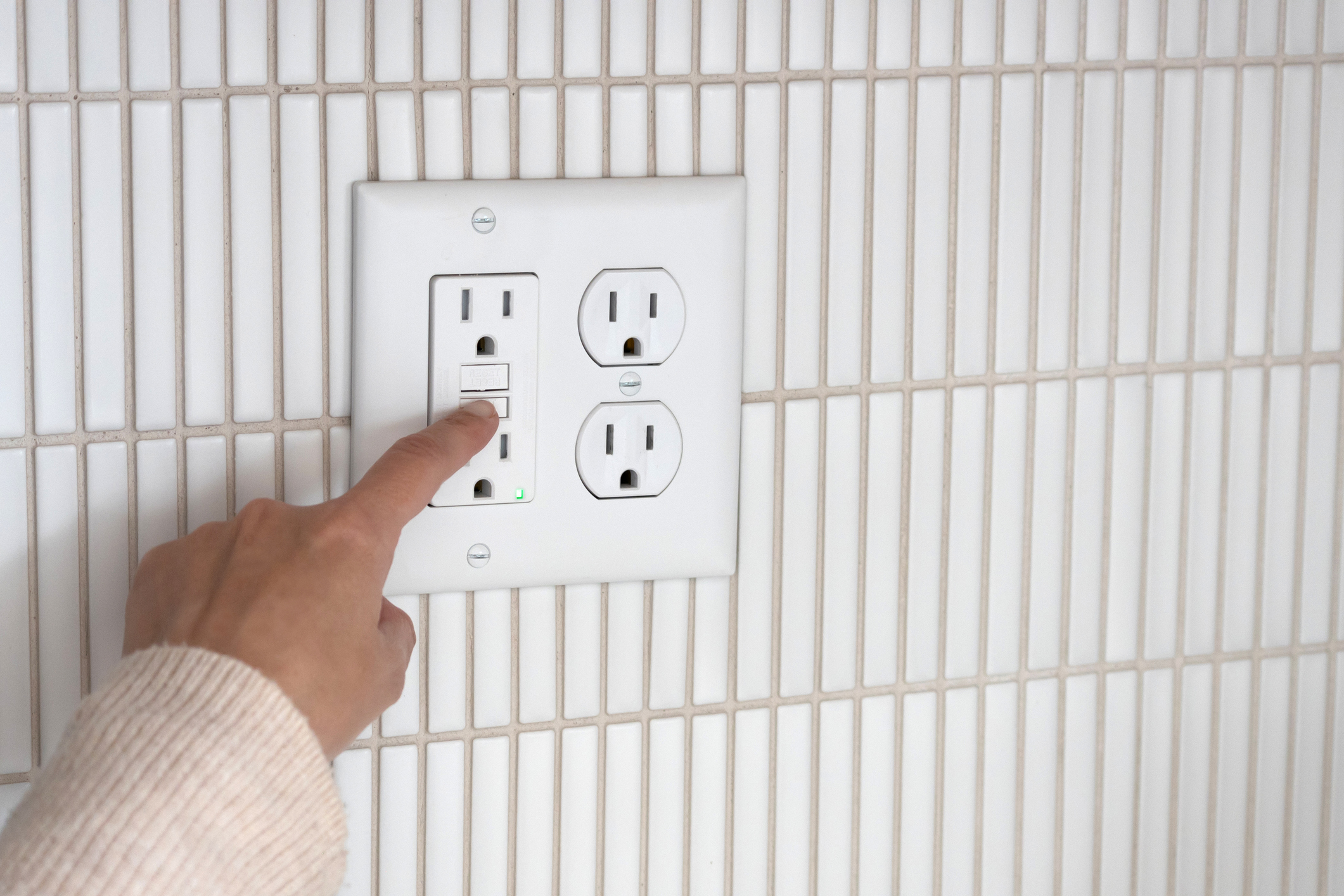
These two outlet types look almost identical — same white plastic face, same TEST and RESET buttons — and they’re constantly confused with each other. But the GFCI vs AFCI outlets differences go well beyond appearances. They protect against completely different hazards, are required in different rooms by the National Electrical Code (NEC), and cannot substitute for one another. If you have the wrong one in the wrong place, you may have a real protection gap and not know it. This guide walks through what each device does, where it’s required, and how to tell what you already have.
Disclosure: This article contains affiliate links. If you purchase through these links, we may earn a small commission at no extra cost to you. As an Amazon Associate, we earn from qualifying purchases.
What GFCI Outlets Do — and the Specific Hazard They Prevent
A ground fault is an unintended path for electrical current to flow to ground — often through a person’s body. This happens when you touch a live outlet with wet hands, drop a plugged-in hair dryer into a full sink, or use a corded tool in the rain. The current takes the path of least resistance. If you’re standing between the outlet and the ground, that path runs through you.
The dangerous part: it doesn’t take much. As little as 5 milliamps (mA) can cause ventricular fibrillation. That’s about 1/20th the current drawn by a 60-watt bulb. A standard circuit breaker won’t trip until 15 to 20 amps of current flow — thousands of times more than what can kill someone. Standard breakers protect wiring, not people.
A GFCI (Ground Fault Circuit Interrupter) outlet solves this by continuously monitoring the balance between current flowing out through the hot wire and current returning through the neutral wire. If there’s a difference of about 5mA — meaning some current is going somewhere it shouldn’t — the GFCI trips in under 1/10 of a second. That’s fast enough to prevent electrocution in most scenarios.
You’ll recognize a GFCI outlet by the TEST and RESET buttons on its face. If you need to replace a standard outlet in a bathroom, kitchen, or other wet location, a residential GFCI outlet is the component you’re looking for.
Where the hazard lives: anywhere water and electricity share the same space. That means bathrooms, kitchens near sinks, garages, outdoor outlets, crawl spaces, and unfinished basements.
What AFCI Outlets Do — and Why the Threat Is Completely Different
An arc fault is a dangerous electrical discharge. It happens when current jumps across a gap in a circuit — through damaged wiring insulation, a loose connection at a terminal, or a cord pinched under furniture for years.
Arc faults are not the same as short circuits. A short circuit draws a huge surge of current that trips a breaker. An arc fault can produce relatively normal current levels. But it still generates enough heat to start a fire. That fire starts inside the wall where you can’t see it. A standard breaker won’t catch it. Neither will a GFCI device.
An AFCI (Arc Fault Circuit Interrupter) outlet uses electronics to recognize the specific waveform of an arc discharge. It identifies the pattern the arc creates in the circuit. Then it trips before dangerous heat builds up.
The scenarios AFCI prevents:
- Old wiring with cracked or brittle insulation making intermittent contact
- A staple driven through a cable behind drywall during a renovation
- A lamp cord run under a rug for years and worn thin at a pressure point
- A loose wire terminal connection that creates a small recurring arc
Like GFCI outlets, AFCI outlets have TEST and RESET buttons. They’ll be labeled AFCI or AF on the face of the outlet. They’re sometimes slightly larger than standard outlets due to the additional electronics inside.
GFCI vs AFCI Outlets: Key Differences in Protection, Location, and Code Requirements
Understanding the key differences between GFCI and AFCI outlets starts with recognizing that they address completely separate risks. Neither replaces the other.
| Feature | GFCI | AFCI |
|---|---|---|
| Hazard prevented | Shock / electrocution | Electrical fire |
| What it detects | Current imbalance (ground fault) | Arc discharge waveform signature |
| Typical locations | Wet and damp areas | Bedrooms, living areas, most living spaces |
| Introduced to NEC | 1971 (bathrooms) | 1999 (bedrooms) |
| Triggered by | Moisture, faulty appliances near water | Damaged wiring, loose connections |
| Standard breaker catches it? | No | No |
Older homes — built before 1971 for GFCI in bathrooms, or before 1999 for AFCI in bedrooms — may have neither type installed. This is one of the most common protection gaps found during home inspections and pre-sale electrical reviews.
Where Each Type Is Required by the NEC — Room by Room
The NEC sets national minimum standards. Local jurisdictions can adopt earlier editions or add stricter requirements. Always verify with your local building department when pulling permits or going through an inspection.
The GFCI vs AFCI outlets differences become very practical here — each device maps to a specific set of locations based on the hazard it prevents.
GFCI Required Locations (NEC 2023)
GFCI is required wherever water is present or likely:
- All bathroom receptacles
- Kitchen countertop receptacles within 6 feet of a sink
- Garages and accessory buildings with a floor at or near grade
- All exterior (outdoor) receptacles
- Crawl spaces
- Unfinished basements
- Areas near swimming pools, hot tubs, and sump pumps
- Boathouses
AFCI Required Locations (NEC 2023)
AFCI requirements have expanded significantly over the past 25 years. Under the current NEC, AFCI outlet requirements by room now cover essentially all living spaces in new construction:
- Bedrooms (required since 1999 — the original AFCI requirement)
- Living rooms, family rooms, and dining rooms (added 2014)
- Hallways and closets (added 2017)
- Kitchens and laundry rooms (added 2017)
- Essentially all habitable rooms in new construction
A Practical Note for Existing Homes
Existing homes are generally grandfathered under the code edition in effect when they were built. You are not required to retrofit every room in a 1985 house to meet 2023 NEC requirements just because the code has changed.
But grandfathering has limits. If you pull a permit for a remodel, add a new circuit, or modify existing wiring in a specific area, that work typically must meet current code. Selling a home or having an inspection often surfaces protection gaps that buyers will ask to have addressed. Knowing where each type is required puts you ahead of those conversations.
Can One Outlet Do Both Jobs? Dual-Function AFCI/GFCI Explained
Yes. Dual-function combination outlets provide both AFCI and GFCI protection in a single device. They are NEC-compliant for satisfying both requirements at once.
These are especially useful in rooms that fall under both sets of requirements. Kitchens require AFCI protection under current NEC and GFCI protection at countertop receptacles near sinks. One dual-function outlet handles both — no need to manage two separate devices on the same circuit.
A few practical points:
- Dual-function outlets cost more than single-function outlets. But the price difference is often worth it when a single location needs both types of protection.
- AFCI protection can also be provided at the breaker panel via AFCI breakers. If you have an AFCI breaker protecting the circuit, a standard GFCI outlet at the receptacle handles the remaining requirement.
- Combination devices from manufacturers like Leviton and Eaton are widely available and straightforward to install.
If you’re renovating a kitchen or laundry room and want to address both code requirements cleanly, a dual-function AFCI/GFCI outlet is the right product for the job.
How to Tell Which Type You Already Have — and What to Do If You Have Neither
Identifying What’s Installed
The fastest way to identify an outlet is to read the label on its face. Both GFCI and AFCI outlets have TEST and RESET buttons, but the label will say GFCI, AFCI, or Combination/Dual Function. If the outlet has no buttons and no label, it’s a standard outlet with no protection of either kind.
Also check your breaker panel. AFCI breakers have their own TEST button and will be labeled AFCI or Combination AFCI. If your panel has AFCI breakers protecting bedroom and living area circuits, those circuits have arc fault protection even if the outlets themselves don’t say AFCI.
Using an Outlet Tester
A plug-in GFCI outlet tester is useful for confirming that an outlet is live and wired correctly. It can identify reversed polarity, a missing ground, and an open neutral. But it will not tell you what protection type is installed. For that, you need to read the label on the outlet or breaker. An outlet tester is worth keeping in any homeowner’s toolkit for diagnosing wiring problems at the receptacle level.
What to Do If You Have Neither
For GFCI: Replacing a standard outlet with a GFCI outlet is one of the more approachable homeowner electrical repairs. Turn off the breaker to the circuit, confirm the power is off with a non-contact voltage tester, and follow the wiring instructions that come with the outlet. In most states, this falls within the scope of homeowner DIY electrical work. If your newly installed GFCI outlet won’t reset after the swap, see our guide on GFCI outlet won’t reset: causes and fixes for help diagnosing the problem.
For AFCI: Upgrading typically means installing an AFCI breaker at the panel or replacing the outlet with an AFCI outlet. Panel work carries more risk than outlet-level work. Experienced DIYers can handle AFCI outlet replacements. But if you’re uncertain about the wiring configuration, a licensed electrician is the right call.
One important boundary: If your home has aluminum wiring, knob-and-tube wiring, or outlets with no ground wire, stop before doing any outlet work. Consult a licensed electrician first. These wiring systems require specific approaches that go beyond a straightforward outlet swap.
Frequently Asked Questions
What happens if I use a GFCI where an AFCI is required?
You’ll have shock protection but no arc fault protection. A GFCI outlet will not detect the waveform signature of an arc fault. If damaged wiring behind your walls creates an arc, the GFCI won’t trip. The fire risk remains. These devices protect against different hazards — one cannot cover for the other.
Do I need AFCI in an older home that wasn’t built to current NEC?
Not automatically. Existing homes are generally grandfathered under the code edition in effect when they were built. However, if you renovate, pull permits, or modify wiring in a room, that work typically must meet current NEC requirements — which means AFCI in most living spaces. If you’re unsure what applies to your home, check with your local building department.
Can a GFCI outlet replace an AFCI breaker?
No. A GFCI outlet provides ground fault protection only. It does not provide arc fault protection. If your circuit requires AFCI coverage — for a bedroom, living room, or hallway under current NEC — a GFCI outlet does not satisfy that requirement. You need either an AFCI outlet or an AFCI breaker at the panel.
What does it mean when my AFCI outlet keeps tripping with nothing plugged in?
An AFCI outlet that trips repeatedly with nothing connected may be detecting a wiring problem on the circuit itself — a loose connection, damaged wire insulation, or an issue further back in the circuit that you can’t see. This is not nuisance tripping. It’s the device doing its job. Don’t simply reset it and ignore it. Have a licensed electrician inspect the circuit. If you’re experiencing a similar issue with a GFCI outlet, see our guide on Why your GFCI outlet keeps tripping with nothing plugged in for help diagnosing the most common causes.
Is a dual-function outlet worth the extra cost compared to two separate devices?
In most cases, yes — especially during a renovation. A dual-function outlet costs more than a single GFCI or AFCI outlet, but less than buying two separate devices and managing two sets of requirements. In locations like kitchens or laundry rooms that require both AFCI and GFCI protection, a single dual-function outlet is the cleaner and often more cost-effective solution.
Does my whole house need AFCI protection if it was built before 1999?
No. If your home was built before 1999, it predates the first NEC AFCI requirement for bedrooms. You’re not legally required to retrofit the entire house. That said, AFCI protection significantly reduces the risk of electrical fires from aging wiring. If you’re remodeling or upgrading circuits, adding AFCI coverage in bedrooms and living areas is a worthwhile investment in fire safety — even if it’s not legally mandated for your existing wiring.
Can I install a GFCI or AFCI outlet myself, or does this require an electrician?
For GFCI outlets, replacing a standard outlet yourself is a reasonable DIY project in most states — as long as you turn off the breaker, confirm the power is off, and follow the outlet’s wiring instructions carefully. For AFCI outlets, the replacement process is similar, but diagnosing why an existing outlet isn’t providing protection may require more electrical knowledge. Panel-level work — installing AFCI breakers — carries more risk and is better left to a licensed electrician if you’re not fully comfortable working in the panel.
Conclusion
The core GFCI vs AFCI outlets differences come down to three things:
- GFCI prevents electric shock in wet locations by detecting current imbalances — it’s required in bathrooms, kitchens near sinks, garages, outdoors, and other damp areas
- AFCI prevents electrical fires caused by arc faults in wiring — it’s required in bedrooms, living spaces, hallways, and most habitable rooms in new construction under current NEC
- Neither replaces the other, but dual-function outlets exist for locations that need both protections at once
Knowing which type belongs where — and what’s actually installed in your home — is the foundation for smart decisions during renovations, inspections, and electrical upgrades. When in doubt about what’s installed, read the label on the outlet and check the breakers in your panel. When in doubt about the work itself, a licensed electrician is worth the cost of the service call.
If you have a GFCI outlet that’s already installed but keeps tripping unexpectedly, that’s a separate diagnostic issue — see our guide on outdoor GFCI outlets that keep tripping for help working through the most common causes.